Concert Review: An American In Paris

An American in Paris/ Gershwin/ The Australian Ballet

Theatre Royal, Sydney

3 May 2022

Now that’s entertainment!

An American in Paris – A New Musical has opened its Sydney season and it’s an intoxicating hit. It’s inspired by, but nothing like, the 1951 movie classic, choreographed by and starring Gene Kelly based on the book by Craig Lucas. This new conception has already won four Tony Awards® and had long seasons on Broadway (opening April 2015) and in London’s West End (opening March 2017) after debuting at the Théâtre du Châtelet in Paris (December 2014). 

Directed and choreographed by Christopher Wheeldon, a product of London’s Royal Ballet, the music and lyrics of George and Ira Gershwin have been adapted and arranged by Rob Fisher and a team of creatives to realise this nostalgic and undeniably fun piece of music theatre, produced in Australia by the Australian Ballet, GWB Entertainment and others.

Set in liberated Paris, the imagery is evocative of French aesthetics of the time and before, from Dior’s “New Look” silhouette to softly impressionistic backdrops, Piaf, luxury brands, snobby art galleries and the glamour of cabaret. The outstanding cast is replete with triple-threaters – performers who have equal skills in singing, dancing and acting. What is exciting to see is that 5 of these, including Cameron Holmes and Dimity Azoury, the leads in the alternative cast, are members of the Australian Ballet. Ballet takes a central role in this production.

Gershwin’s innovative music was anchored in his classical musical training which he infused with elements from jazz and blues, ragtime and Afro-Caribbean aesthetics. Likewise, Wheeldon’s choreography also draws on classical traditions as it incorporates other diverse elements. The production hinges very much on the skills of the two principals, Holmes and Azoury. Holmes is a dynamic presence on stage, a high-octane dancer with considerable singing ability who breaks into a series of jetés and pirouettes around the stage in the final ballet scene, reminiscent of Nureyev dancing Le Corsaire. Azoury, a principal artist with the Australian Ballet since 2019 impressed with her dancing, but was less successful with her singing, although her single solo The Man I love was etched with a naïve longing which suited her character. Holmes and Azoury conveyed a good sense of chemistry between them, especially in the sensual pas de deux in the final ballet scene.

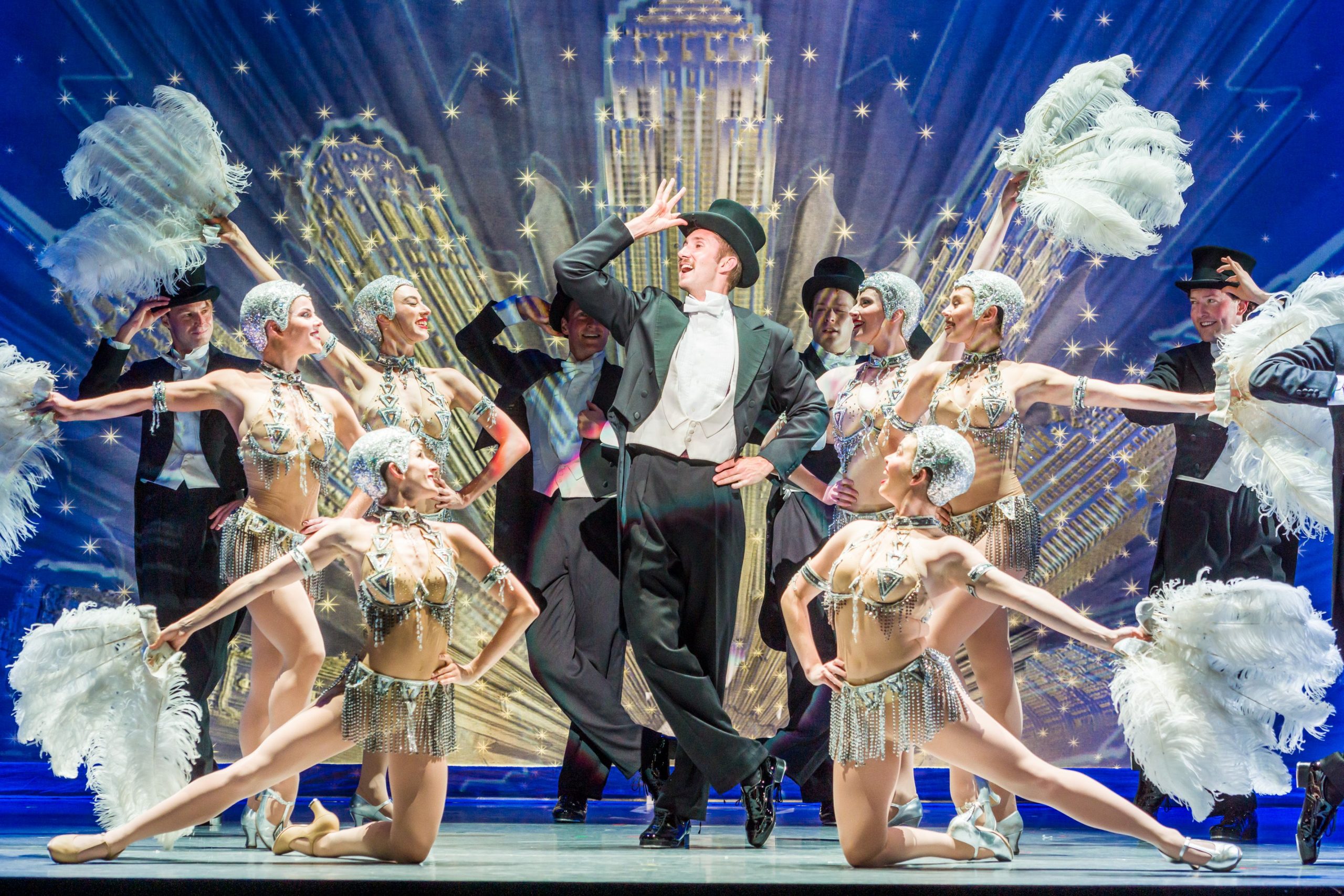
The two other male leads, Sam Ward as Henri Baurel and Jonathan Hickey as Adam Hochberg the pianist, complete the trio, not unlike the three Parisian garret-bound characters in La Bohème. Hickey is not required to dance, but he is charged with narrating some of the tale. Both he and Ashleigh Rubenach as Milo show off their serious vocal ability in their duet But Not For Me. Sam Ward’s comedic talent and vocal chops come to the fore in the infectious step-kick sequins and feather cabaret extravaganza I’ll Build A Stairway to Paradise -finally a tap-dancing number! Anne Wood is perfect as the dour society matron Madame Baurel

It’s a fabulous ensemble of singers and dancers, with sumptuous costumes (which hint at the art of Mondrian in the final ballet scene) exquisite, ever changing digital and real sets, (with a hint of Miro) and a swinging orchestra playing evergreen music – the great hits of George and Ira Gershwin like I Got Rhythm, S’Wonderful, and They Can’t Take That Away from Me – who could ask for anything more?

Shamistha de Soysa for SoundsLikeSydney©

An American in Paris plays at the Theatre Royal in Sydney till 12 June 2022.

Image: An American in Paris at the Theatre Royal in Sydney. Image credit Darren Thomas


Similar Posts

  • Concert Review: Elektra

      ElektraSydney Symphony OrchestraSydney Opera House, Concert HallFebruary 24 As a cathartic experience the Monday evening performance of Richard Strauss’s Elektra by the Sydney Symphony Orchestra would be difficult to surpass. Such was the emotional tension generated by the waves of sheer orchestral power and a dramatic soprano who is nothing short of a vocal phenomenon…

  • Concert Review: Faure’s Requiem From The Sydney Chamber Choir:Shining Light Into Worlds Beyond

     Faure’s Requiem The Sydney Chamber Choir and The Metropolitan Orchestra, April 12 2014. the City Recital Hall, Sydney.   In a world where concert producers seem to draw on a dizzying array of devices to tantalise audiences, the Sydney Chamber Choir delivered a potent reminder of the power of music, dispensing with distractions and focusing…

  • Concert Review: Splendour And Mystery/Sydney Chamber Choir

    Splendour and Mystery/ Sydney Chamber Choir
    Verbrugghen Hall, Sydney Conservatorium of Music
    Australian Digital Concert Hall
    25 March, 2023
    In Splendour and Mystery, Sydney Chamber Choir under the direction of Sam Allchurch joined forces with Camerata Antica led by Matthew Manchester and organist Thomas Wilson in an adventurous anthology of music written for double choir. Specialising in the music of the 16th and 17th centuries, the founder of Camerata Antica, Matthew Manchester playing the fiendishly difficult cornetto, was joined by Michael Wyborn, William Kinmont and Paolo Franks playing the equally challenging alto, tenor and bass sackbutts respectively.
    Bookended with pieces by Giovanni Gabrieli with one of his refreshing Canzonas in the middle, the program also contained music by living Australasian composers Clare Maclean and Brooke Shelley, Gabrieli’s contemporary and student Heinrich Schütz and 20th century composers John Tavener and Frank Martin. Together these composers explore and exploit the potential of the double choir with its opportunities for super-rich harmonies, added melodic lines, imitation, choral interplay and variations in the positioning of the singers.
    The opening motet, Gabrieli’s Jubilate Deo omnis terra, C 65 was quite literally a musical shout for joy. A major part of this journey back in time to Renaissance Venice was the unique sound of Camerata Antica. Heralded by the instruments, the 10 lines of the choir sang an uplifting, lively and tightly dotted chorus, alternating with homophonic passages. Allchurch and his ensemble clearly delineated the rhythms, changing time signatures, hemiolas and other displaced accents which created the buoyancy of this celebratory piece.
    John Tavener’s brilliant A Hymn to the Mother of God transcends the mortal and looks to the cosmic powers of Mother Mary. Writing in the style of canon, with imitative lines that start in quick succession and not necessarily in harmony, Tavener creates a sense of ‘other-worldliness’ in this simple but awe-inducing piece in three-sections. It was a slow burn as the two choirs sang with shimmering lightness and a sense of spinning through space, creating vivid colours and  clusters of clashing chords with impressive control as the voices rose in range and dynamic to its full-bodied climax.
    The program moved imperceptibly to the German Magnificat by Heinrich Schütz, as the choirs were joined by organ and instruments. This was a relevant and important inclusion as Gabrieli himself taught Schütz in this multi-choral technique which Schütz then developed in his own style.
    Clare Maclean’s moving Christ the King was sublimely sung, opening in the manner of a plainchant by the female voices which peeled off into mirroring phrases by the other voices, ending in a reprise of the plainchant. Premiered by this choir in 1984, it is precisely opportunities like these which new composers need for their music to be heard and re-heard until it becomes recognizable to listeners and enters the DNA of the concert repertoire.
    The short and brilliant burst of Gabrieli’s Canzona seconda, C 187  from Camerata Antica showcased these rudimentary instruments in all their imperfect glory as the choir positioned itself for Frank’s only unaccompanied choral work, the demanding  Mass for double choir, considered to be one of the finest and most complex pieces of 20th century choral music. The choir did ample justice to this piece which incorporates the aesthetics of Renaissance music, French Impressionism, Schoenberg’s twelve-note system and J S Bach. The altos began the Kyrie with a freely-flowing, supplicating melody; the Gloria built step-wise to cluster chords; the Credo was a business-like affirmation of faith; the canon-styled Et Resurrexit was levity, hope and word-painting to perfection; the Sanctus introduced softer harmonies from the male voices. The mass, Version 1, ended with a powerful Benedictus. Fast forward to 1926 and Martin added the Agnus Dei, the crowning glory to this choral magnum opus. The mass culminated in a glorious unification of the choirs.
    Brooke Shelley’s Heavenly Father, composed in 2022, performed in the presence of the composer was premiered in November 2022, by the Sydney Chamber Choir. A lyrical and beautifully textured piece, it is very pleasing that it has quickly been programmed again. Like the slightly older piece by Maclean, it is critical that new pieces of merit such as these, are given regular and frequent hearings so that they may be heard widely and face the test of time.
    Finally, Gabrieli’s Magnificat a 14, C 79 brought together the full instrumental and vocal forces of the ensemble. Using the 16th century Venetian technique of cori spezzati (split choirs), the brighter sound of the female voices and cornetto took to the left gallery with the male voices and the thrilling grunt of the bass and other sackbutts in the right gallery with a mixed ensemble placed and organ placed centrally on stage.
    This was an intelligent and audacious program from Allchurch, performed with glorious sound by a choir secure in technique, pitch and musicianship.

  • Concert Review: Sato and the Romantics/Australian Brandenburg Orchestra

    Australian Brandenburg Orchestra Violin soloist Shunske Sato,  Artistic Director Paul Dyer 7 September 2016, City Recital Hall, Angel Place Written by Larry Turner The Australian Brandenburg Orchestra’s Artistic Director, Paul Dyer, continually searches for new repertoire for the ABO or new perspectives for familiar repertoire. In the fourth concert of their 2016 series they left…

  • Concert Review: Australian Chamber Choir/ Bach In The Castle Of Heaven

    The Australian Chamber Choir, conductor Douglas Lawrence August 21, 2016, Crypt of St Mary’s Cathedral, Sydney   It was an afternoon of heavenly music presented by the Melbourne based Australian Chamber Choir, directed by Douglas Lawrence. Inspired by John Eliot Gardiner’s tome Bach: Music in the Castle of Heaven, the programme, Bach in the Castle…

  • Concert Review: Schubert Immersion Weekend / Seraphim Trio

      Seraphim Trio: Helen Ayres (violin), Anna Goldsworthy (piano), Tim Nankervis (cello) With Jacqui Cronin (viola), David Campbell (double bass)  10-11 September 2016, The Independent Theatre, North Sydney Written by Larry Turner The Seraphim Trio has nominated 2016 as ‘our year of total immersion in Schubert’.  This culminated in a splendid weekend when they presented…

One Comment

Leave a Reply

Your email address will not be published. Required fields are marked *