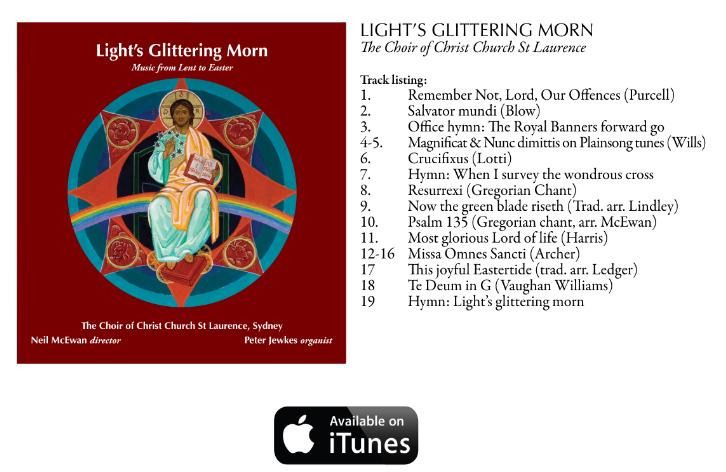
CD Review: Light’s Glittering Morn, The Choir of Christ Church St Laurence
CCSLCD006-254-800-600-80-rd-255-255-255
Image: detail from Christ the King (2005) from The Orthodox Art Series by Earle Backen courtesy Christ Church St Laurence


Commemorating the season of Lent, The Choir of Christ Church St Laurence in Sydney has released an anthology of seasonal music from Lent to Easter, titled Light’s Glittering Morn.

Directed by Dr Neil McEwen AM,  with organist Peter Jewkes, the 34 strong choir sings 14 works from Gregorian chant to the 20th century which observe “the liturgical calendar…. and present(s ) music in a similar context to that which is provided in the liturgies at Christ Church St Laurence.” This journey from Lent to Easter embraces an extraordinary breadth of repertoire which includes hymns and chants, anthems and a mass, songs and a Te Deum.

The programming has embraced the opposing sentiments of death and resurrection without too much brooding, looking forward to the optimism of Easter as suggested by the title of the recording. Lent is traditionally a time of introspection and abstinence. There is an acknowledgement of these moods in selections like Antonio Lotti’s sublimely beautiful Crucifixus and the hymn When I survey the wondrous cross; there are pleas for absolution in Purcell’s Remember not, Lord, our offences and John Blow’s Salvator Mundi – all antecedents, liturgically speaking, to the resurrection which is celebrated with selections which include Resurrexi, an ancient Gregorian chant in Mode IV sung on Easter Day, Simon Lindley’s arrangement of the French Traditional Now the green blade riseth and Philip Ledger’s arrangement of the Dutch carol This Joyful Eastertide, culminating in the hymn by Ralph Vaughan-Williams from which the CD takes its name.

Light’s Glittering Morn is an opportunity to revel in the beauty of seamlessly blended choral voices,  the resounding power of organ improvisation, to be swept to the heights of descant counter melody and to immerse yourself in the rich history of this music for which the liner notes provide important detail, along with the full text of all the works (except the Missa Omnes Sancti).

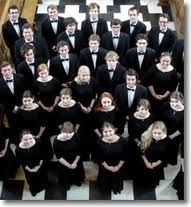
The Choir of Christ Church St Laurence is regarded as one of Sydney’s finest liturgical ensembles. Conductor and early music scholar Dr Neil McEwen has a long and highly acclaimed association with the choir. They deliver the wide ranging stylistic demands and colours of this programme moving from pared down Plainsong, polyphony and the dance- like ring of This Joyful Eastertide to the  hushed reverence of supplication in Salvator Mundi and the full-voiced homophonic thrust of anthems and hymns –  opening in unison then diverging into parts with descant.

Being of the faith isn’t a pre-requisite to appreciating this CD. Sacred values apart, the musicians are a pleasure to hear, the repertoire reaches beyond the absolute value of the music, deep into people, places and times in history; the notes have an abundance of information.

Shamistha de Soysa for SoundsLikeSydney©

The CD costs $30 and is available on iTunes and the Parish Office.
 

Similar Posts

  • Concert Review: Splendour And Mystery/Sydney Chamber Choir

    Splendour and Mystery/ Sydney Chamber Choir
    Verbrugghen Hall, Sydney Conservatorium of Music
    Australian Digital Concert Hall
    25 March, 2023
    In Splendour and Mystery, Sydney Chamber Choir under the direction of Sam Allchurch joined forces with Camerata Antica led by Matthew Manchester and organist Thomas Wilson in an adventurous anthology of music written for double choir. Specialising in the music of the 16th and 17th centuries, the founder of Camerata Antica, Matthew Manchester playing the fiendishly difficult cornetto, was joined by Michael Wyborn, William Kinmont and Paolo Franks playing the equally challenging alto, tenor and bass sackbutts respectively.
    Bookended with pieces by Giovanni Gabrieli with one of his refreshing Canzonas in the middle, the program also contained music by living Australasian composers Clare Maclean and Brooke Shelley, Gabrieli’s contemporary and student Heinrich Schütz and 20th century composers John Tavener and Frank Martin. Together these composers explore and exploit the potential of the double choir with its opportunities for super-rich harmonies, added melodic lines, imitation, choral interplay and variations in the positioning of the singers.
    The opening motet, Gabrieli’s Jubilate Deo omnis terra, C 65 was quite literally a musical shout for joy. A major part of this journey back in time to Renaissance Venice was the unique sound of Camerata Antica. Heralded by the instruments, the 10 lines of the choir sang an uplifting, lively and tightly dotted chorus, alternating with homophonic passages. Allchurch and his ensemble clearly delineated the rhythms, changing time signatures, hemiolas and other displaced accents which created the buoyancy of this celebratory piece.
    John Tavener’s brilliant A Hymn to the Mother of God transcends the mortal and looks to the cosmic powers of Mother Mary. Writing in the style of canon, with imitative lines that start in quick succession and not necessarily in harmony, Tavener creates a sense of ‘other-worldliness’ in this simple but awe-inducing piece in three-sections. It was a slow burn as the two choirs sang with shimmering lightness and a sense of spinning through space, creating vivid colours and  clusters of clashing chords with impressive control as the voices rose in range and dynamic to its full-bodied climax.
    The program moved imperceptibly to the German Magnificat by Heinrich Schütz, as the choirs were joined by organ and instruments. This was a relevant and important inclusion as Gabrieli himself taught Schütz in this multi-choral technique which Schütz then developed in his own style.
    Clare Maclean’s moving Christ the King was sublimely sung, opening in the manner of a plainchant by the female voices which peeled off into mirroring phrases by the other voices, ending in a reprise of the plainchant. Premiered by this choir in 1984, it is precisely opportunities like these which new composers need for their music to be heard and re-heard until it becomes recognizable to listeners and enters the DNA of the concert repertoire.
    The short and brilliant burst of Gabrieli’s Canzona seconda, C 187  from Camerata Antica showcased these rudimentary instruments in all their imperfect glory as the choir positioned itself for Frank’s only unaccompanied choral work, the demanding  Mass for double choir, considered to be one of the finest and most complex pieces of 20th century choral music. The choir did ample justice to this piece which incorporates the aesthetics of Renaissance music, French Impressionism, Schoenberg’s twelve-note system and J S Bach. The altos began the Kyrie with a freely-flowing, supplicating melody; the Gloria built step-wise to cluster chords; the Credo was a business-like affirmation of faith; the canon-styled Et Resurrexit was levity, hope and word-painting to perfection; the Sanctus introduced softer harmonies from the male voices. The mass, Version 1, ended with a powerful Benedictus. Fast forward to 1926 and Martin added the Agnus Dei, the crowning glory to this choral magnum opus. The mass culminated in a glorious unification of the choirs.
    Brooke Shelley’s Heavenly Father, composed in 2022, performed in the presence of the composer was premiered in November 2022, by the Sydney Chamber Choir. A lyrical and beautifully textured piece, it is very pleasing that it has quickly been programmed again. Like the slightly older piece by Maclean, it is critical that new pieces of merit such as these, are given regular and frequent hearings so that they may be heard widely and face the test of time.
    Finally, Gabrieli’s Magnificat a 14, C 79 brought together the full instrumental and vocal forces of the ensemble. Using the 16th century Venetian technique of cori spezzati (split choirs), the brighter sound of the female voices and cornetto took to the left gallery with the male voices and the thrilling grunt of the bass and other sackbutts in the right gallery with a mixed ensemble placed and organ placed centrally on stage.
    This was an intelligent and audacious program from Allchurch, performed with glorious sound by a choir secure in technique, pitch and musicianship.

  • Concert Review: Avi Avital and the Australian Brandenburg Orchestra

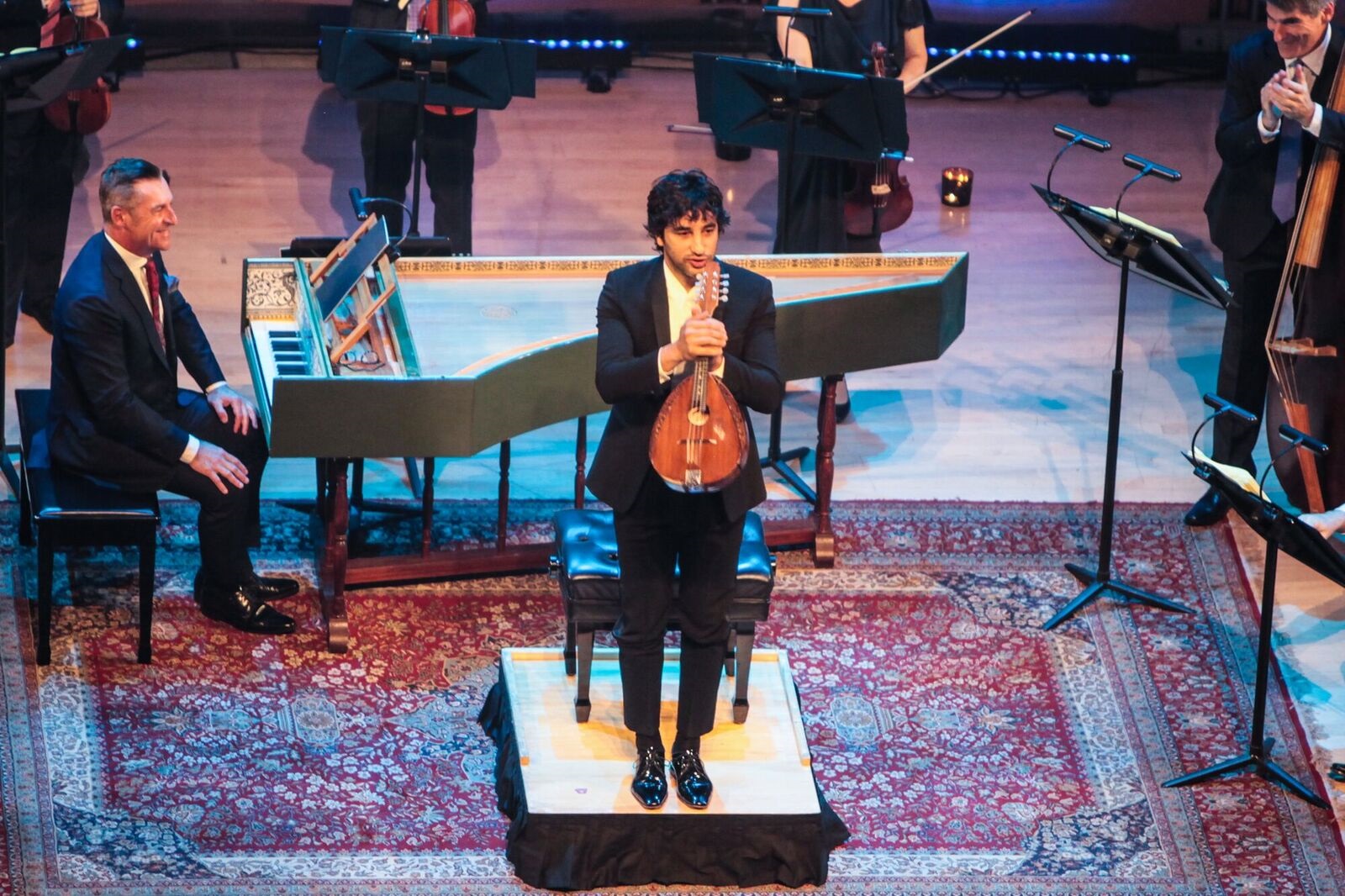
     Australian Brandenburg Orchestra  Avi Avital, mandolin 26 October 2016, City Recital Hall, Angel Place  Written by Larry Turner Two years ago the Israeli-born mandolin player Avi Avital gave a very successful series of concerts with the Australian Brandenburg Orchestra. Now he has returned to a celebrity welcome from the ABO’s Artistic Director, Paul Dyer, who…

  • CD Reviews: Especially For Movie Buffs – Spectre And Music From Star Wars

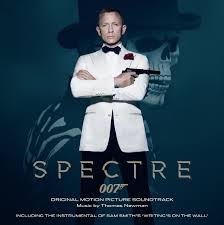
    Especially for movie buffs, Decca has released two CDs to coincide with the premieres of two holiday blockbusters. Spectre is the soundtrack from the James Bond movie of the same name; John Williams Conducts Music from Star Wars is a double album compilation of astral-themed music synchronised with the launch of the latest in the…

  • Album Review: The Garden Party/ The Marais Project

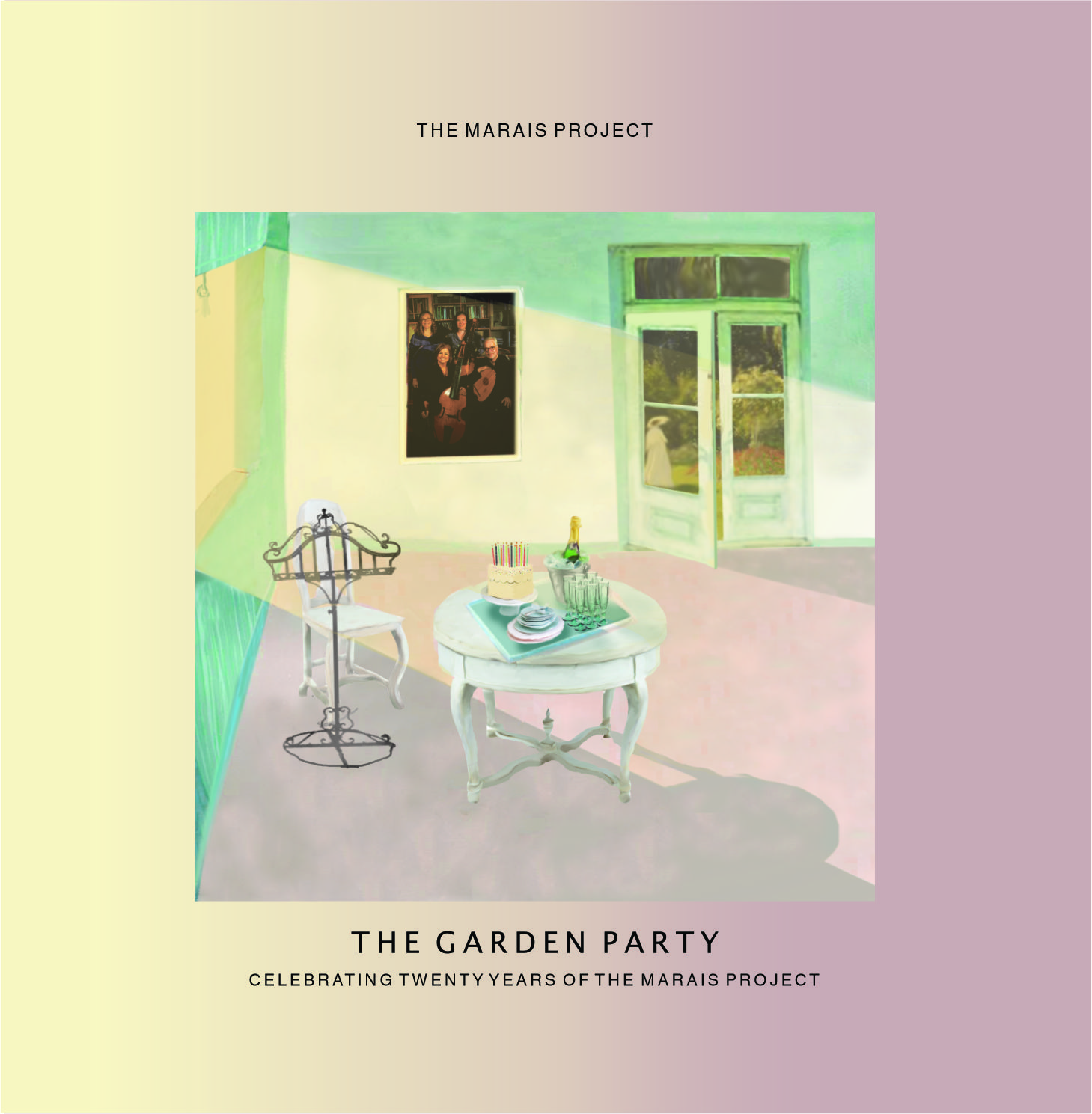
    The Garden Party, The Marais Project/ Move Records Celebrating two decades of professional music making, The Marais Project has released a new recording, The Garden Party on the Move label, featuring fresh repertoire and new collaborators alongside some previously recorded pieces with older friends. The Marais Project was founded by viola da gamba player Jennifer…

Leave a Reply

Your email address will not be published. Required fields are marked *