Album Review: Hemispheres/ Sally Walker/ Philip Mayers
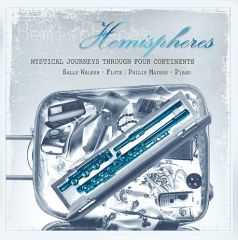
Hemispheres

Hemispheres is a gem of a CD, which, like many independent recordings, has slipped under the radar of the mainstream press.

Described as ‘Mystical journeys through four continents’ Hemispheres was recorded by flautist Sally Walker with pianist Philip Mayers, both prodigiously gifted Australian musicians with impressive international careers.

The anthology represents eleven 20th century composers from Europe, Asia, South America and Australia, amongst them Australia’s Paul Stanhope, Anne Boyd, Richard Meale and Marian Budos with Frank Martin, Ernst Bloch, Vanraj Bhatia, David Matthews, Jindřich Feld, Coco Nelegatti and Pēteris Vasks. Given the flute’s ubiquitous presence through time and across cultures, a feature that Walker explores in her liner notes, the music we hear on Hemispheres is a refreshing and challenging expansion to conventional flute recital repertoire. The 19 tracks on the album add to just under 80 minutes of music and include 6 world premiere recordings.

Hemispheres allows both flautist and pianist to showcase their technical mastery and versatility in style, working very much as equal partners. Walker establishes her credentials opening with the intensely chromatic Ballade for Flute and Piano by Frank Martin which ends in an explosion of bravura playing. There is the impossibly demanding Ainava ar Putniem (Landscapes with Birds) by the Latvian Pēteris Vasks and Czech composer Jindřich Feld’s Quatre Pièces pour Flûte Seule, both unaccompanied, which reveal the sheer beauty and myriad sounds which Walker draws from her instrument. She creates a pulsating gambol with the intrinsic rhythmicity and folk-style ornamentation of London-based Indian-born Vanraj Bhatia’s Dance in Night Music; the selections by Nelegatti are played with a languorous, improvisatory Latin feel which allows Mayers to demonstrate his sensitivity but also his virtuosity. Anne Boyd’s Red Sun, Chill Wind, pushes the boundaries, calling for extended techniques between flute and piano, with intriguing effect.

Sally Walker has an active performing and recording career and regularly collaborates with the Australian Chamber Orchestra as well as holding an academic appointment as Lecturer in Flute and Academic Studies at the University of Newcastle. She worked extensively in Europe performing with the Leipzig Gewandhaus Orchestra, the Berlin Philharmonic and the City of Birmingham Symphony Orchestra, amongst others, before returning to settle in Australia in 2006. Berlin-based Philip Mayers maintains a busy performing and recording career as pianist, vocal coach, chamber musician and conductor, with concert appearances that have included the Aldeburgh and Montreaux Festivals, London’s Purcell Room and the Concertgebouw in Amsterdam. He has worked with the RIAS-Kammerchor and Capella Amsterdam and his appointments as Music Director have included the Berlin Kammeroper and the Konzerthaus Berlin.

Recorded in the Mendelssohn-Haus, Leipzig, Hemispheres was released on the Chartreuse label in 2013. With Hemispheres, Walker and Mayers together demonstrate the universality and the versatility of the flute, whether sophisticated or rustic; in the salon or the pasture. It is an important exploration of techniques and of modern flute repertoire with previously unrecorded works by both established and emerging composers. Brilliantly performed.

Shamistha de Soysa for SoundsLikeSydney©


Similar Posts

  • Opera Review: Il Viaggio A Reims/ Opera Australia

    Il Viaggio a Reims Opera Australia Joan Sutherland Theatre, Sydney Opera House, October 24th, 2019 Written by Victoria Watson The father of 19th century bel canto Gioachino Rossini wrote Il Viaggio a Reims specifically to coincide with and celebrate the 1825 coronation of the previously exiled King Charles X at Reims in rural France. The libretto…

  • Concert Review: Splendour And Mystery/Sydney Chamber Choir

    Splendour and Mystery/ Sydney Chamber Choir
    Verbrugghen Hall, Sydney Conservatorium of Music
    Australian Digital Concert Hall
    25 March, 2023
    In Splendour and Mystery, Sydney Chamber Choir under the direction of Sam Allchurch joined forces with Camerata Antica led by Matthew Manchester and organist Thomas Wilson in an adventurous anthology of music written for double choir. Specialising in the music of the 16th and 17th centuries, the founder of Camerata Antica, Matthew Manchester playing the fiendishly difficult cornetto, was joined by Michael Wyborn, William Kinmont and Paolo Franks playing the equally challenging alto, tenor and bass sackbutts respectively.
    Bookended with pieces by Giovanni Gabrieli with one of his refreshing Canzonas in the middle, the program also contained music by living Australasian composers Clare Maclean and Brooke Shelley, Gabrieli’s contemporary and student Heinrich Schütz and 20th century composers John Tavener and Frank Martin. Together these composers explore and exploit the potential of the double choir with its opportunities for super-rich harmonies, added melodic lines, imitation, choral interplay and variations in the positioning of the singers.
    The opening motet, Gabrieli’s Jubilate Deo omnis terra, C 65 was quite literally a musical shout for joy. A major part of this journey back in time to Renaissance Venice was the unique sound of Camerata Antica. Heralded by the instruments, the 10 lines of the choir sang an uplifting, lively and tightly dotted chorus, alternating with homophonic passages. Allchurch and his ensemble clearly delineated the rhythms, changing time signatures, hemiolas and other displaced accents which created the buoyancy of this celebratory piece.
    John Tavener’s brilliant A Hymn to the Mother of God transcends the mortal and looks to the cosmic powers of Mother Mary. Writing in the style of canon, with imitative lines that start in quick succession and not necessarily in harmony, Tavener creates a sense of ‘other-worldliness’ in this simple but awe-inducing piece in three-sections. It was a slow burn as the two choirs sang with shimmering lightness and a sense of spinning through space, creating vivid colours and  clusters of clashing chords with impressive control as the voices rose in range and dynamic to its full-bodied climax.
    The program moved imperceptibly to the German Magnificat by Heinrich Schütz, as the choirs were joined by organ and instruments. This was a relevant and important inclusion as Gabrieli himself taught Schütz in this multi-choral technique which Schütz then developed in his own style.
    Clare Maclean’s moving Christ the King was sublimely sung, opening in the manner of a plainchant by the female voices which peeled off into mirroring phrases by the other voices, ending in a reprise of the plainchant. Premiered by this choir in 1984, it is precisely opportunities like these which new composers need for their music to be heard and re-heard until it becomes recognizable to listeners and enters the DNA of the concert repertoire.
    The short and brilliant burst of Gabrieli’s Canzona seconda, C 187  from Camerata Antica showcased these rudimentary instruments in all their imperfect glory as the choir positioned itself for Frank’s only unaccompanied choral work, the demanding  Mass for double choir, considered to be one of the finest and most complex pieces of 20th century choral music. The choir did ample justice to this piece which incorporates the aesthetics of Renaissance music, French Impressionism, Schoenberg’s twelve-note system and J S Bach. The altos began the Kyrie with a freely-flowing, supplicating melody; the Gloria built step-wise to cluster chords; the Credo was a business-like affirmation of faith; the canon-styled Et Resurrexit was levity, hope and word-painting to perfection; the Sanctus introduced softer harmonies from the male voices. The mass, Version 1, ended with a powerful Benedictus. Fast forward to 1926 and Martin added the Agnus Dei, the crowning glory to this choral magnum opus. The mass culminated in a glorious unification of the choirs.
    Brooke Shelley’s Heavenly Father, composed in 2022, performed in the presence of the composer was premiered in November 2022, by the Sydney Chamber Choir. A lyrical and beautifully textured piece, it is very pleasing that it has quickly been programmed again. Like the slightly older piece by Maclean, it is critical that new pieces of merit such as these, are given regular and frequent hearings so that they may be heard widely and face the test of time.
    Finally, Gabrieli’s Magnificat a 14, C 79 brought together the full instrumental and vocal forces of the ensemble. Using the 16th century Venetian technique of cori spezzati (split choirs), the brighter sound of the female voices and cornetto took to the left gallery with the male voices and the thrilling grunt of the bass and other sackbutts in the right gallery with a mixed ensemble placed and organ placed centrally on stage.
    This was an intelligent and audacious program from Allchurch, performed with glorious sound by a choir secure in technique, pitch and musicianship.

Leave a Reply