Review: Bittersweet Obsessions: Monteverdi And Bach/ Australian Brandenburg Orchestra
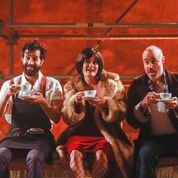
Karim Sulayman, Natasha Wilson and Jakob Bloch Jesperson in the Australian Brandenburg Orchestra's Bittersweet Obsessions. Image courtesy Steven Godbee Publicity Photography
Karim Sulayman, Natasha Wilson and Jakob Bloch Jesperson in the Australian Brandenburg Orchestra’s Bittersweet Obsessions. Image courtesy Steven Godbee Publicity Photography

Bittersweet Obsessions: Monteverdi and Bach

Australian Brandenburg Orchestra

City Recital Hall

25 October 2017

The Australian Brandenburg Orchestra’s Bittersweet Obsessions: Monteverdi and Bach is an engaging pastiche of early and baroque music, performed in a dramatised setting by thirteen members of the orchestra, led by concertmaster Shaun Lee-Chen. Joined by four vocal soloists – New Zealand soprano Natasha Wilson, tenors Karim Sulayman from America and Australian Spencer Darby and Danish baritone Jakob Bloch Jesperson, the ensemble was directed from the harpsichord by ABO artistic director, Paul Dyer.

Director Constantine Costi, lighting designer John Rayment and set designer Charlotte Mungomery created an undeniable sense of theatre with the stage set for story-telling, adorned with a backdrop featuring a pastoral scene, tufts of grass scattered about the stage whilst musicians occupied a makeshift ‘pit’ on the auditorium floor. A fine mist filled the air as the cymbals built to a crescendo introducing the curtain raiser, Giovanni Girolamo Kapsberger’s Toccata arpeggiata – a cameo for the theorbo. Kapsberger took the theorbo to new heights as a solo instrument, and this arpeggiated piece with its unusual rhythms and syncopations, brilliantly played by Tommie Andersson certainly set the scene for the evening. In this arrangement, the theorbo was joined by several other instruments, percussion effects and an attractive vocalise from Wilson. For the more curious members of the audience the source of the arrangement would have made the excellent programme notes just a little more complete.

This programme is another of the ABO’s ventures into combining theatre with their customary instrumental offerings. Dyer chose two of Monteverdi’s celebrated compositions which paved the way for the development of opera. The Lamento della ninfa is a setting of a canzonetta with text by Rinuccini. Clad in costumes by Genevieve Graham, the three male voices singing the parts of the shepherds, captivated with an easy blend and even balance, delivered in pure style. Wilson’s incisive, rich and bright tones soared against the antiphon of the men.

The palate-cleansing, dance-like Ciaccona by the Neapolitan Andrea Falconieri, invigorated by the rhythm of the castanets, faded to Monteverdi’s Overture to Il ritorno d’Ulisse in patria, presaging Monteverdi’s other significant setting of verse by Tasso, the Combattimento di Tancredi et Clorinda, written for a private performance for Girolamo Mocenigo in Venice. The pastoral backcloth gave way to reveal scaffolding, skilfully used to project the surtitles as well as to depict the two protagonists, ably performed by Wilson and Jesperson, with Sulayman proving a very gifted narrator, using his light and lucid voice to excellent dramatic effect. On stage, character surrogates and Aikido performers Melanie Lindenthal and Andrew Sunter enacted the scenes of combat between Tancredi and Clorinda, with Clorinda’s death proving an especially vivid moment enhanced by the lighting design. The instrumentalists had their own points to make with Monteverdi’s pioneering orchestration depicting the sounds of the horses, the battle and painting a picture in music of Clorinda’s death. The singers and instrumentalists maintained an excellent sense of ensemble with the singers moving seamlessly from declamatory statements to arioso style. The drama closed with a sobering epilogue in the form of Giovanni Maria Trabaci’s Conzonanze stravaganti.

The familiar strains of the first movement of JS Bach’s Brandenburg Concerto no 4, BWV 1049, opened the post-interval segment, performed by just one instrument per part. Shaun Lee-Chen dazzled with his ornamentation. However, taken at a sprightly tempo, the overall effect was buoyant but may have been the source of some lack of cohesion within the ensemble.

It was a pleasing preamble to Bach’s Schweigt stille, plaudert nicht (Be still, stop chattering), BWV 211 which is better known as the Coffee Cantata. A rare secular vocal work by the great master, it is more of a comic operetta than a cantata and satirises the fascination at the time with coffee, an exotic import that was considered to be a social evil. Transported by Costi and his creative team to present times, Sulayman’s Narrator was a barista whose bar would be the envy of every self-respecting barista in Sydney. Jesperson as Schlendrian the father, and Wilson as Lieschen the brattish daughter, locked horns in a perennial predicament as the parent battling to set boundaries for the wilful and defiant child.

Natasha Wilson carried her role with comic flair. Her aria Ei! Wie schmeckt der Kaffee süße with the baroque flute played by Melissa Farrow was a highlight, proving a voice that is well-anchored though agile and consistently beautiful through her range. Supported by the Kiri Te Kanawa and Dame Malvina Major Foundations, her aesthetic and timbre are well suited to early styles. She is an emerging singer of great promise and is someone to watch with interest.

Accompanied by comprehensive notes, insights, biographies and illustrations in the printed programme, Bittersweet Obsessions is an assemblage of works which can stand alone on their musical merits. However, the ABO’s striking dramatisations and the interpolation of related smaller works, adds an extra dimension and brings these masterworks to life in a most entertaining way.

Shamistha de Soysa for SoundsLikeSydney©

The Australian Brandenburg Orchestra’s Bittersweet Obsessions continues at the City Recital Hall in Sydney on selected days until 1 November 2017.


Similar Posts

  • extraordinary tale – extraordinary singing from the idea of north

    As always, The Idea of North delight listeners with their  new CD. Their freshness,  purity of tone and unerring pitch, blend like the strands of a braid that start and end their journey together, meandering their own part in between, independent, but never losing sight of being part of the single design. Extraordinary Tale (ABC…

  • A Celtic Inspired Noël! Noël! From The Australian Brandenburg Orchestra

      Noël! Noël! the Australian Brandenburg Orchestra’s annual Christmas concert is in its 15th year. The series has become a seasonal fixture with concerts in churches and concert halls in and around Sydney, as well as in Wollongong. “In  Noël! Noël! we blend the ancient with the modern in our arrangements and also instrumentally,” says…

  • CD Review: Amuse-Bouche/ I Fagiolini

    I Fagiolini, the British vocal ensemble directed and conducted by Robert Hollingworth, celebrates its thirtieth anniversary with a new recording, Amuse-Bouche (Decca Classics 478 9394), a 29 track collection of ‘French choral delicacies’ from the late 19th and early 20th centuries, released in April 2016. To highlight the Australian connections, I Fagiolini toured Australia in 2015 for Musica…

  • Concert Review: Splendour And Mystery/Sydney Chamber Choir

    Splendour and Mystery/ Sydney Chamber Choir
    Verbrugghen Hall, Sydney Conservatorium of Music
    Australian Digital Concert Hall
    25 March, 2023
    In Splendour and Mystery, Sydney Chamber Choir under the direction of Sam Allchurch joined forces with Camerata Antica led by Matthew Manchester and organist Thomas Wilson in an adventurous anthology of music written for double choir. Specialising in the music of the 16th and 17th centuries, the founder of Camerata Antica, Matthew Manchester playing the fiendishly difficult cornetto, was joined by Michael Wyborn, William Kinmont and Paolo Franks playing the equally challenging alto, tenor and bass sackbutts respectively.
    Bookended with pieces by Giovanni Gabrieli with one of his refreshing Canzonas in the middle, the program also contained music by living Australasian composers Clare Maclean and Brooke Shelley, Gabrieli’s contemporary and student Heinrich Schütz and 20th century composers John Tavener and Frank Martin. Together these composers explore and exploit the potential of the double choir with its opportunities for super-rich harmonies, added melodic lines, imitation, choral interplay and variations in the positioning of the singers.
    The opening motet, Gabrieli’s Jubilate Deo omnis terra, C 65 was quite literally a musical shout for joy. A major part of this journey back in time to Renaissance Venice was the unique sound of Camerata Antica. Heralded by the instruments, the 10 lines of the choir sang an uplifting, lively and tightly dotted chorus, alternating with homophonic passages. Allchurch and his ensemble clearly delineated the rhythms, changing time signatures, hemiolas and other displaced accents which created the buoyancy of this celebratory piece.
    John Tavener’s brilliant A Hymn to the Mother of God transcends the mortal and looks to the cosmic powers of Mother Mary. Writing in the style of canon, with imitative lines that start in quick succession and not necessarily in harmony, Tavener creates a sense of ‘other-worldliness’ in this simple but awe-inducing piece in three-sections. It was a slow burn as the two choirs sang with shimmering lightness and a sense of spinning through space, creating vivid colours and  clusters of clashing chords with impressive control as the voices rose in range and dynamic to its full-bodied climax.
    The program moved imperceptibly to the German Magnificat by Heinrich Schütz, as the choirs were joined by organ and instruments. This was a relevant and important inclusion as Gabrieli himself taught Schütz in this multi-choral technique which Schütz then developed in his own style.
    Clare Maclean’s moving Christ the King was sublimely sung, opening in the manner of a plainchant by the female voices which peeled off into mirroring phrases by the other voices, ending in a reprise of the plainchant. Premiered by this choir in 1984, it is precisely opportunities like these which new composers need for their music to be heard and re-heard until it becomes recognizable to listeners and enters the DNA of the concert repertoire.
    The short and brilliant burst of Gabrieli’s Canzona seconda, C 187  from Camerata Antica showcased these rudimentary instruments in all their imperfect glory as the choir positioned itself for Frank’s only unaccompanied choral work, the demanding  Mass for double choir, considered to be one of the finest and most complex pieces of 20th century choral music. The choir did ample justice to this piece which incorporates the aesthetics of Renaissance music, French Impressionism, Schoenberg’s twelve-note system and J S Bach. The altos began the Kyrie with a freely-flowing, supplicating melody; the Gloria built step-wise to cluster chords; the Credo was a business-like affirmation of faith; the canon-styled Et Resurrexit was levity, hope and word-painting to perfection; the Sanctus introduced softer harmonies from the male voices. The mass, Version 1, ended with a powerful Benedictus. Fast forward to 1926 and Martin added the Agnus Dei, the crowning glory to this choral magnum opus. The mass culminated in a glorious unification of the choirs.
    Brooke Shelley’s Heavenly Father, composed in 2022, performed in the presence of the composer was premiered in November 2022, by the Sydney Chamber Choir. A lyrical and beautifully textured piece, it is very pleasing that it has quickly been programmed again. Like the slightly older piece by Maclean, it is critical that new pieces of merit such as these, are given regular and frequent hearings so that they may be heard widely and face the test of time.
    Finally, Gabrieli’s Magnificat a 14, C 79 brought together the full instrumental and vocal forces of the ensemble. Using the 16th century Venetian technique of cori spezzati (split choirs), the brighter sound of the female voices and cornetto took to the left gallery with the male voices and the thrilling grunt of the bass and other sackbutts in the right gallery with a mixed ensemble placed and organ placed centrally on stage.
    This was an intelligent and audacious program from Allchurch, performed with glorious sound by a choir secure in technique, pitch and musicianship.

  • Concert Review: Six Times Three/ Sydney Chamber Choir

    Six Times Three Sydney Chamber Choir  Great Hall Sydney University September 6, 2015  In its final concert for 2015, celebrating its 40th year, the Sydney Chamber Choir welcomed its newly appointed Music Director Richard Gill OAM, as conductor, in a (mostly) a capella, numerologically themed program of music by six Antipodean composers – three men…

  • Concert Review: Australian Brandenburg Orchestra/ Dmitri Sinkovsky

    Dmitri Sinkovsky with the Australian Brandenburg Orchestra, City Recital Hall, July 23rd, 2014. It’s not too rare for an instrumental musician to swap instrument for baton or to direct an ensemble from the instrument. However, I can’t recall any musician proficient enough in the practice of two instruments (and that includes voice), to perform both…

Leave a Reply