Review: Otello/Opera Australia

Otello

Opera in 4 acts by Giuseppe Verdi, libretto by Arrigo Boito,

The Joan Sutherland Theatre, Sydney Opera House, Opera Australia,

Saturday July 5, 2014.
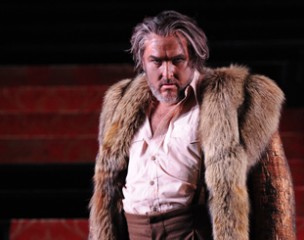
A cascade of succulent sound - Simon O'Neill as Otello. Image Branco Gaica, courtesy Opera Australia
A cascade of succulent sound – Simon O’Neill as Otello. Image Branco Gaica, courtesy Opera Australia

With a few strategic sweeps of his baton, conductor Christian Badea unleashed the full force of the Opera Australia orchestra and chorus, igniting the slow burning fuse of the opera that is Verdi’s Otello.

This 2014 revival of Harry Kupfer’s production, seen in Sydney in 2003 and 2008, is centred around a damaged and decaying staircase in the middle of which stands a larger than life figure of Atlas carrying the weight of the world on his shoulders. Otello is as world-weary and therefore vulnerable to the manipulations of his ensign Iago, after whom the opera was nearly named. Despite his victory against the Venetians, Otello’s personal world is crumbling.

Singing the draining role of Otello, New Zealand born heldentenor Simon O’Neill makes a welcome return to Sydney. He was heard here in 2009 as Seryózha, in Lady Macbeth of Mtensk  for Opera Australia and in Mahler’s  8th Symphony with the Sydney Symphony Orchestra under Vladimir Ashkenazy. It is hard to imagine how O’Neill could possibly have given more, dramatically or vocally.  The cascade of succulent  sound from O’Neill was stunning as he raged against Iago in Tu? Indietro!Fuggi! and against his perceived infidelity of Desdemona and Cassio in Sì, pel ciel marrmoreo guiro!  The moments of intimacy he shared with Desdemona, the woman he loved with such controlling passion, were sung with supreme tenderness and delicacy (Già nella notte densa).

Singing Desdemona at short notice was Armenian soprano Lianna Haroutounian, whose previous performances in the role include the Teatro San Carlo in Naples and the Opera Bastille in Paris. As the dutiful but naive and wronged wife, she was magnificent, fulfilling Verdi’ s own words:

“Desdemona is a part in which the thread, the melodic line, never ceases from the first note to the last. Just as Jago has only to declaim and laugh mockingly, and just as Otello, now the warrior, now the passionate lover, now crushed to the point of baseness, now ferocious like a savage, must sing and shout, so Desdemona must always, always sing.”

Haroutounian’s  interpretation of Ave Maria, (incidentally, sung by Bulgarian soprano Raina Kabaivanska at the funeral of Luciano Pavarotti in 2007) was exceptional for its ethereal beauty and sense of tragedy after the gosssamer lightness and poignancy of Piangea cantando (the Willow Song).

Claudio Sgura sang rich voiced and malevolent as the nihilistic Iago in the trio of compelling principals.  

James Egglestone as Cassio, Richard Anderson as Montano, David Corcoran as Roderigo, Jacqueline Dark as Emilia and Pelham Andrews as Lodovoco completed a vocally and dramatically robust ensemble.

It is curious to see how the tradition of ‘blacking up’ the Moor persists even in the 21st century when Sydney audiences are surely accustomed to singers of many nationalities from Takesha Meshe Kizart as Tosca, to Jonathan Lemalu as Leporello and Yonghoon Lee as Cavaradossi playing the roles of Europeans, and Cheryl Barker and Patricia Racette taking roles like Cio-Cio San without cosmetic enhancement. Regardless of the production or how dextrous the transformation, the practice of darkening Caucasian skins seems to be reminiscent  of  less enlightened times and an idea whose effectiveness is passing into the realm of caricature.

Whilst 2013 was the year of Verdi’s bi-centenary, the homage continues with this outstanding  presentation by Opera Australia, alongside the very successful new production of Rigoletto, another mainstay of Verdi’s canon.

Shamistha de Soysa for SoundsLikeSydney©

Otello is being performed at the Joan Sutherland Theatre of the Sydney Opera House on selected evenings and afternoons until August 2nd 2014.

View the Otello picture gallery.

Read our review of Rigoletto.

Similar Posts

  • Opera Review: The Magic Flute/ Opera Australia

     The Magic Flute  –  W. A. Mozart Opera Australia, 7 January 2016 Joan Sutherland Opera Theatre, Sydney Opera House. Julie Taymor’s 2005 New York Metropolitan Opera production of Mozart’s The Magic Flute was first adapted for Sydney in 2012 and is now having its fourth series of performances in Opera Australia’s summer season.  It is…

  • Concert Review: Songs Of Remembrance/The Choir Of St James’ King Street

    Over the past few years, Remembrance Day seems to have grown in the public heart. Of a more universal scope than its January counterpart, ANZAC Day, Remembrance Day’s theme is of the senseless suffering worldwide caused by war. With the increasing prominence of the commemoration comes a similar realisation of the quality of the associated…

  • Concert Review: Splendour And Mystery/Sydney Chamber Choir

    Splendour and Mystery/ Sydney Chamber Choir
    Verbrugghen Hall, Sydney Conservatorium of Music
    Australian Digital Concert Hall
    25 March, 2023
    In Splendour and Mystery, Sydney Chamber Choir under the direction of Sam Allchurch joined forces with Camerata Antica led by Matthew Manchester and organist Thomas Wilson in an adventurous anthology of music written for double choir. Specialising in the music of the 16th and 17th centuries, the founder of Camerata Antica, Matthew Manchester playing the fiendishly difficult cornetto, was joined by Michael Wyborn, William Kinmont and Paolo Franks playing the equally challenging alto, tenor and bass sackbutts respectively.
    Bookended with pieces by Giovanni Gabrieli with one of his refreshing Canzonas in the middle, the program also contained music by living Australasian composers Clare Maclean and Brooke Shelley, Gabrieli’s contemporary and student Heinrich Schütz and 20th century composers John Tavener and Frank Martin. Together these composers explore and exploit the potential of the double choir with its opportunities for super-rich harmonies, added melodic lines, imitation, choral interplay and variations in the positioning of the singers.
    The opening motet, Gabrieli’s Jubilate Deo omnis terra, C 65 was quite literally a musical shout for joy. A major part of this journey back in time to Renaissance Venice was the unique sound of Camerata Antica. Heralded by the instruments, the 10 lines of the choir sang an uplifting, lively and tightly dotted chorus, alternating with homophonic passages. Allchurch and his ensemble clearly delineated the rhythms, changing time signatures, hemiolas and other displaced accents which created the buoyancy of this celebratory piece.
    John Tavener’s brilliant A Hymn to the Mother of God transcends the mortal and looks to the cosmic powers of Mother Mary. Writing in the style of canon, with imitative lines that start in quick succession and not necessarily in harmony, Tavener creates a sense of ‘other-worldliness’ in this simple but awe-inducing piece in three-sections. It was a slow burn as the two choirs sang with shimmering lightness and a sense of spinning through space, creating vivid colours and  clusters of clashing chords with impressive control as the voices rose in range and dynamic to its full-bodied climax.
    The program moved imperceptibly to the German Magnificat by Heinrich Schütz, as the choirs were joined by organ and instruments. This was a relevant and important inclusion as Gabrieli himself taught Schütz in this multi-choral technique which Schütz then developed in his own style.
    Clare Maclean’s moving Christ the King was sublimely sung, opening in the manner of a plainchant by the female voices which peeled off into mirroring phrases by the other voices, ending in a reprise of the plainchant. Premiered by this choir in 1984, it is precisely opportunities like these which new composers need for their music to be heard and re-heard until it becomes recognizable to listeners and enters the DNA of the concert repertoire.
    The short and brilliant burst of Gabrieli’s Canzona seconda, C 187  from Camerata Antica showcased these rudimentary instruments in all their imperfect glory as the choir positioned itself for Frank’s only unaccompanied choral work, the demanding  Mass for double choir, considered to be one of the finest and most complex pieces of 20th century choral music. The choir did ample justice to this piece which incorporates the aesthetics of Renaissance music, French Impressionism, Schoenberg’s twelve-note system and J S Bach. The altos began the Kyrie with a freely-flowing, supplicating melody; the Gloria built step-wise to cluster chords; the Credo was a business-like affirmation of faith; the canon-styled Et Resurrexit was levity, hope and word-painting to perfection; the Sanctus introduced softer harmonies from the male voices. The mass, Version 1, ended with a powerful Benedictus. Fast forward to 1926 and Martin added the Agnus Dei, the crowning glory to this choral magnum opus. The mass culminated in a glorious unification of the choirs.
    Brooke Shelley’s Heavenly Father, composed in 2022, performed in the presence of the composer was premiered in November 2022, by the Sydney Chamber Choir. A lyrical and beautifully textured piece, it is very pleasing that it has quickly been programmed again. Like the slightly older piece by Maclean, it is critical that new pieces of merit such as these, are given regular and frequent hearings so that they may be heard widely and face the test of time.
    Finally, Gabrieli’s Magnificat a 14, C 79 brought together the full instrumental and vocal forces of the ensemble. Using the 16th century Venetian technique of cori spezzati (split choirs), the brighter sound of the female voices and cornetto took to the left gallery with the male voices and the thrilling grunt of the bass and other sackbutts in the right gallery with a mixed ensemble placed and organ placed centrally on stage.
    This was an intelligent and audacious program from Allchurch, performed with glorious sound by a choir secure in technique, pitch and musicianship.

  • Concert Review: Hatched/Ensemble Offspring

    Ensemble Offspring: Hatched Music Workshop, Sydney Conservatorium of Music Thursday, October 30 at 8pm Callum G’Froerer, trumpet/ Jeremy Rose, saxophone/ Claire Edwardes, percussion/ Jason Noble, clarinet/ Lamorna Nightingale, flute The Hatched Academy has been a once-in-a-lifetime experience for its two inaugural ‘hatchlings’, Melbourne-based trumpeter Callum G’Froerer and composer/saxophonist Jeremy Rose. Ensemble Offspring artistic directors Claire…

Leave a Reply