Review: The Chimney Sweep/ Pinchgut Opera

 The Chimney Sweep (Der Rauchfangkehrer)

Musikalisches Lustspiel in three acts by Antonio Salieri, libretto by Joseph Leopold Auenbrugger. Performed in the vernacular.

City Recital Hall, Monday July 7th 2014.

Pinchgut Opera.
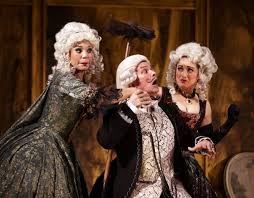
Janet Todd, Christopher Saunders and Amelia Farrugia Photo : Keith Saunders, courtesy Pinchgut Opera.
Janet Todd, Christopher Saunders and Amelia Farrugia
Photo : Keith Saunders, courtesy Pinchgut Opera.

At a time when opera companies are wringing their hands over budgets and trimming expenses back to the core, Sydney’s Pinchgut Opera has made a courageous venture in presenting for the first time, a mid-year offering in addition to its traditional sparkler at the end of the year.

And that’s not all. The annual December event which has become something of a fixture on the calendar since Pinchgut’s first offering in 2002, has focused on early opera, apart from two operas by Mozart (Idomeneo) and Haydn (L’anima del filosofo). This winter presentation of Antonio Salieri’s The Chimney Sweep is a foray into the realm of singspiel, or Musikalisches Lustspiel (although it has been said that the work is more akin to the Italian opera buffa).

 The opera’s alternative English title is The Indispensable Betrayers of Their Lordships’ Self-interest. A product of the Age of Enlightenment, it is the exact anti-thesis to Pinchgut’s staple fare of  serious early opera.

The Chimney Sweep has all the ingredients of the comedies of the late 18th century – the lives of the bourgeoisie and money – money for marriage, money as inheritance or – just not enough of it. It premiered in 1781 at the Vienna Burgtheater, built under the auspices of  Joseph II. It was his intention that it be a venue for both the aristocracy and the populace to attend entertainment that was accessible to all. The opera represented foil to the established operas and operettas. Class conflict is at the core of  the tale.
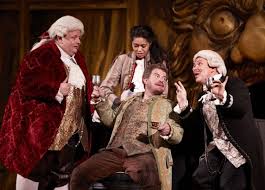
David Woloszko, Sabryna Te'o, Stuart Haycock and Christopher Saunders. Photo: Keith Saunders, courtesy Pinchgut Opera.
David Woloszko, Sabryna Te’o, Stuart Haycock and Christopher Saunders.
Photo: Keith Saunders, courtesy Pinchgut Opera.

Performed in English with lyrics by Andrew Johnston and the dialogue translated by director Mark Gaal, sopranos Amelia Farrugia as Mrs Hawk and Janet Todd as Miss Hawk stole the show, deftly moving from speech to the stratospheric leaps demanded by Salieri’s punishing vocal writing. Their voices were well matched; their comic timing and  flawless technique assured gratifying and entertaining characterisations.

Stuart Haycock in the title role as Volpino, Alexandra Oomens as Lisel, Christopher Saunders as Mr Wolf,  David Wolosko as Mr Bear and David Hidden as Master Tomaso created a compact ensemble with impeccable performances underpinned by artful casting, sumptuous costumes and meticulous attention to accessories and props.
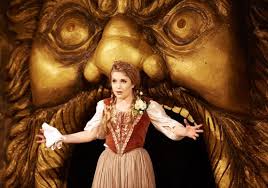
Nicole Oomens. Photo Keith Saunders, courtesy Pinchgut Opera.

Music director Erin Helyard ‘s jazzy, hi-octane direction of the Orchestra of the Antipodes, from the harpsichord (with a roguish reference to Mozart’s Eine Kleine Nachtmusik) nailed the ensemble, propelling the narrative ever forward.

Pinchgut’s innovative staging of opera in what is effectively a recital hall has never failed to  delight. For The Chimney Sweep, the stage was dominated by a chimney the surround of which was reminiscent of  La Bocca della Verità (The Mouth of Truth), a Roman landmark  which achieved popular fame in the Gregory Peck/Audrey Hepburn movie Roman Holiday. Its connection with this production being the myth that it would bite off the hands of liars. Given the duplicity of the characters in the tale, La Bocca was an apt backdrop to the drama and its appetite sated.

At the end of the first act, La Bocca was transformed into a woodland scene with mock solemnity, for the opera within the opera of the allegorical Abduction of Ganymede,  the players acting out the buffoonery for which Salieri was renowned.

Saving one of the best features for the end, dozens of endearing albeit grubby chimney sweeps from the Sydney Children’s Choir joined in the finale swelling the sound of the ensemble with a freshness and energy that underscored the universality and mirth of the story’s moral:

“Long life to all women, all men, and all creatures!

Take chances, live boldly and true to your natures.

Spend all of your days in exciting adventures!……

…….Embrace this queer world and all its paradoxes,

For soon we will all of us end up in boxes.”

Salieri composed The Chimney Sweep at the command of Joseph II. It was performed 13 times in Vienna during 1781–2. Hot on its heels came the premiere of Mozart’s The Abduction from the Seraglio (Die Entführung aus dem Serail) K. 384 written for the same opera company and which is said to have eclipsed Salieri’s work.

How ironic that Mozart’s librettist Da Ponte, wrote more operas for Salieri than for Mozart. La cifra (1789) was a precursor of Così fan tutte, a libretto intended for Salieri but one that he discarded. Likewise, in 1791 Salieri declined the libretto which became Mozart’s La clemenza di Tito.

The success of this production by Pinchgut Opera which stared down two breaks with their traditions represents a coming of age for the company and is a testament to its maturity and the calibre of its presentations.

Shamistha de Soysa for SoundsLikeSydney©

SoundsLikeSydney accepts no fee for reviews.


Similar Posts

  • Concert Review: Splendour And Mystery/Sydney Chamber Choir

    Splendour and Mystery/ Sydney Chamber Choir
    Verbrugghen Hall, Sydney Conservatorium of Music
    Australian Digital Concert Hall
    25 March, 2023
    In Splendour and Mystery, Sydney Chamber Choir under the direction of Sam Allchurch joined forces with Camerata Antica led by Matthew Manchester and organist Thomas Wilson in an adventurous anthology of music written for double choir. Specialising in the music of the 16th and 17th centuries, the founder of Camerata Antica, Matthew Manchester playing the fiendishly difficult cornetto, was joined by Michael Wyborn, William Kinmont and Paolo Franks playing the equally challenging alto, tenor and bass sackbutts respectively.
    Bookended with pieces by Giovanni Gabrieli with one of his refreshing Canzonas in the middle, the program also contained music by living Australasian composers Clare Maclean and Brooke Shelley, Gabrieli’s contemporary and student Heinrich Schütz and 20th century composers John Tavener and Frank Martin. Together these composers explore and exploit the potential of the double choir with its opportunities for super-rich harmonies, added melodic lines, imitation, choral interplay and variations in the positioning of the singers.
    The opening motet, Gabrieli’s Jubilate Deo omnis terra, C 65 was quite literally a musical shout for joy. A major part of this journey back in time to Renaissance Venice was the unique sound of Camerata Antica. Heralded by the instruments, the 10 lines of the choir sang an uplifting, lively and tightly dotted chorus, alternating with homophonic passages. Allchurch and his ensemble clearly delineated the rhythms, changing time signatures, hemiolas and other displaced accents which created the buoyancy of this celebratory piece.
    John Tavener’s brilliant A Hymn to the Mother of God transcends the mortal and looks to the cosmic powers of Mother Mary. Writing in the style of canon, with imitative lines that start in quick succession and not necessarily in harmony, Tavener creates a sense of ‘other-worldliness’ in this simple but awe-inducing piece in three-sections. It was a slow burn as the two choirs sang with shimmering lightness and a sense of spinning through space, creating vivid colours and  clusters of clashing chords with impressive control as the voices rose in range and dynamic to its full-bodied climax.
    The program moved imperceptibly to the German Magnificat by Heinrich Schütz, as the choirs were joined by organ and instruments. This was a relevant and important inclusion as Gabrieli himself taught Schütz in this multi-choral technique which Schütz then developed in his own style.
    Clare Maclean’s moving Christ the King was sublimely sung, opening in the manner of a plainchant by the female voices which peeled off into mirroring phrases by the other voices, ending in a reprise of the plainchant. Premiered by this choir in 1984, it is precisely opportunities like these which new composers need for their music to be heard and re-heard until it becomes recognizable to listeners and enters the DNA of the concert repertoire.
    The short and brilliant burst of Gabrieli’s Canzona seconda, C 187  from Camerata Antica showcased these rudimentary instruments in all their imperfect glory as the choir positioned itself for Frank’s only unaccompanied choral work, the demanding  Mass for double choir, considered to be one of the finest and most complex pieces of 20th century choral music. The choir did ample justice to this piece which incorporates the aesthetics of Renaissance music, French Impressionism, Schoenberg’s twelve-note system and J S Bach. The altos began the Kyrie with a freely-flowing, supplicating melody; the Gloria built step-wise to cluster chords; the Credo was a business-like affirmation of faith; the canon-styled Et Resurrexit was levity, hope and word-painting to perfection; the Sanctus introduced softer harmonies from the male voices. The mass, Version 1, ended with a powerful Benedictus. Fast forward to 1926 and Martin added the Agnus Dei, the crowning glory to this choral magnum opus. The mass culminated in a glorious unification of the choirs.
    Brooke Shelley’s Heavenly Father, composed in 2022, performed in the presence of the composer was premiered in November 2022, by the Sydney Chamber Choir. A lyrical and beautifully textured piece, it is very pleasing that it has quickly been programmed again. Like the slightly older piece by Maclean, it is critical that new pieces of merit such as these, are given regular and frequent hearings so that they may be heard widely and face the test of time.
    Finally, Gabrieli’s Magnificat a 14, C 79 brought together the full instrumental and vocal forces of the ensemble. Using the 16th century Venetian technique of cori spezzati (split choirs), the brighter sound of the female voices and cornetto took to the left gallery with the male voices and the thrilling grunt of the bass and other sackbutts in the right gallery with a mixed ensemble placed and organ placed centrally on stage.
    This was an intelligent and audacious program from Allchurch, performed with glorious sound by a choir secure in technique, pitch and musicianship.

  • Australia Ensemble And Sydney Children’s Choir: A Flock Of Stars

    The Australia Ensemble is delighted to be joined by the Sydney Children’s Choir and celebrated musical director Lyn Williams OAM, in A Flock of Stars, a program named for one of her works. In this choral and instrumental collaboration, the  music performed is mainly by Australian composers. The evening begins in the dubious surrounds of…

  • Scholl records Bach cantatas

      Counter-tenor Andres Scholl has released a recording of cantatas by JS Bach, revisiting repertoire that he first sang as a young treble. The Decca recording (CD 478 2733) was made with the kammerorchesterbasel and was released internationally in January 2012. It is also available for download. Scholl’s recent performances at Symphony Hall, Birmingham; the Barbican, London;…

  • Concert Review: ‘Collusion’/The Marais Project

    ‘Collusion’ The Marais Project: Jenny Eriksson with Susie Bishop, Emily-Rose Šárkova and Eliska Sarka Recital Hall West, Sydney Conservatorium 24 August 2014.  2014 marks the fifteenth anniversary of the Marais Project and their director Jennifer Eriksson has adopted a theme of Re-imaginings which she explains is ‘taking the opportunity to re-imagine my instrument, the viola da…

  • Concert Review: Songs Of The Divine, The Choir of St James’ King Street

      The Choir and Orchestra of St James St James, King Street, Sydney 22 March 2014 Songs of the Divine – Baroque Masterpieces  For the first concert in their 2014 series, the choir and orchestra of St James, under the direction of Warren Trevelyan-Jones, turned to the two pillars of the musical Baroque: Bach and…

Leave a Reply