Seduced by the song company in La Serenissima
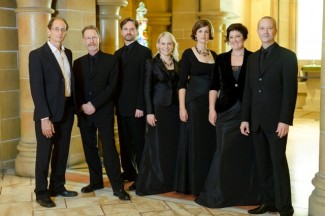
 

The Song Company Love in Venice

The City Recital Hall, Sydney

Wednesday March 14th 2012

The contemporary relevance of 16th century European music is ever real.  Roland Peelman, Artistic Director of The Song Company proved this when he chose 9 madrigals composed between 1603 and 1619, from Claudio Monteverdi’s vast oeuvre, and paired them with the highly theatrical madrigal opera Barca de Venetia per Padova by Adriano Banchieri  for his troupe to perform with Tommie Andersson (theorbo/guitar) and Laura Vaughan (lirone/viol).

He also proved that serious music doesn’t have to be po-faced and dour; its performance can be burlesque and satirical; it can entertain and engage without drawing on voyeurism or crushingly concrete references to contemporary society.

The Monteverdi madrigals with text by various poets, amongst them Petrarca, Marino and Guarini, took up the first part of Love in Venice. The audience was clearly delighted. Anti-phonal effects were intensified with sopranos Susannah Lawergren and Anna Fraser singing the first madrigal from either end of the rest of the ensemble which comprised mezzo-soprano Lanneke Jones, tenor Richard Black, baritone Mark Donnelly and bass Clive Birch. Other configurations were adopted through out, enhancing the vocal part writing and balance, most effectively with Lawergren singing a wistful Oimè il bel viso from the top gallery with the rest of the ensemble below.

The musicians took the audience from cerebral love through to breathless expressions of fulfilment. I for one, was left with a yearning to be on a gondola on a romantic backwater in La Serenissima.

The second part of the concert involved an aquatic journey of a different kind. A few simple props transformed the singers into an assortment of characters from the commedia dell’ arte, who find themselves having to fraternise together on a boat as they journey from Venice to Padua. They are caricatures of everyday people thrown together by a common purpose and sharing a common fate, rather like the omnium-gatherum in an Agatha Christie mystery or Michael Ondaatje’s latest novel The Cat’s Table. However, in Barca nobody dies. This group is about embracing love and life and the singers seem to relish it. There is flirtation aplenty as they moved about the stage, food and wine, and even the penniless wounded soldier returning from the wars is given short shrift.

Roland Peelman’s unobtrusive direction from the harpsichord was meticulous as always. Even he took on a role and had the rare opportunity to to wince visibly as his singers sang their characters. It was a thrill to see the rare lirone and to hear early music experts Tommie Andersson and Laura Vaughan perform.

The madrigals were sung in Italian, with intervening narrative spoken by the singers in English. The alternation between the two languages was seamless. The ornamentation was especially important as a marker of a historically informed performance. It fleshed out the texture of the writing, added drama and beautified the words and their meaning. As a device Monteverdi’s ornamentation was part of his statement adopting the seconda prattica using dissonance and ornaments to create effect and opening the doors to new means of expression in music.

This was an elegant presentation and the audience loved it.

Shamistha de Soysa for SoundsLikeSydney


Similar Posts

  • Concert Review: The Musician Project/ Wagner And Bruckner

    The Musician Project,  Verbrugghen Hall, Sydney Conservatorium of Music 30 September 2017 Written by Ria Andriani The Musician Project is one of the newest and most innovative orchestras in town. Its young players are filled with exuberance and creativity, and its artistic team has several bright ideas up its sleeves: creative programming, imaginative notes, pay…

  • Concert Review: Splendour And Mystery/Sydney Chamber Choir

    Splendour and Mystery/ Sydney Chamber Choir
    Verbrugghen Hall, Sydney Conservatorium of Music
    Australian Digital Concert Hall
    25 March, 2023
    In Splendour and Mystery, Sydney Chamber Choir under the direction of Sam Allchurch joined forces with Camerata Antica led by Matthew Manchester and organist Thomas Wilson in an adventurous anthology of music written for double choir. Specialising in the music of the 16th and 17th centuries, the founder of Camerata Antica, Matthew Manchester playing the fiendishly difficult cornetto, was joined by Michael Wyborn, William Kinmont and Paolo Franks playing the equally challenging alto, tenor and bass sackbutts respectively.
    Bookended with pieces by Giovanni Gabrieli with one of his refreshing Canzonas in the middle, the program also contained music by living Australasian composers Clare Maclean and Brooke Shelley, Gabrieli’s contemporary and student Heinrich Schütz and 20th century composers John Tavener and Frank Martin. Together these composers explore and exploit the potential of the double choir with its opportunities for super-rich harmonies, added melodic lines, imitation, choral interplay and variations in the positioning of the singers.
    The opening motet, Gabrieli’s Jubilate Deo omnis terra, C 65 was quite literally a musical shout for joy. A major part of this journey back in time to Renaissance Venice was the unique sound of Camerata Antica. Heralded by the instruments, the 10 lines of the choir sang an uplifting, lively and tightly dotted chorus, alternating with homophonic passages. Allchurch and his ensemble clearly delineated the rhythms, changing time signatures, hemiolas and other displaced accents which created the buoyancy of this celebratory piece.
    John Tavener’s brilliant A Hymn to the Mother of God transcends the mortal and looks to the cosmic powers of Mother Mary. Writing in the style of canon, with imitative lines that start in quick succession and not necessarily in harmony, Tavener creates a sense of ‘other-worldliness’ in this simple but awe-inducing piece in three-sections. It was a slow burn as the two choirs sang with shimmering lightness and a sense of spinning through space, creating vivid colours and  clusters of clashing chords with impressive control as the voices rose in range and dynamic to its full-bodied climax.
    The program moved imperceptibly to the German Magnificat by Heinrich Schütz, as the choirs were joined by organ and instruments. This was a relevant and important inclusion as Gabrieli himself taught Schütz in this multi-choral technique which Schütz then developed in his own style.
    Clare Maclean’s moving Christ the King was sublimely sung, opening in the manner of a plainchant by the female voices which peeled off into mirroring phrases by the other voices, ending in a reprise of the plainchant. Premiered by this choir in 1984, it is precisely opportunities like these which new composers need for their music to be heard and re-heard until it becomes recognizable to listeners and enters the DNA of the concert repertoire.
    The short and brilliant burst of Gabrieli’s Canzona seconda, C 187  from Camerata Antica showcased these rudimentary instruments in all their imperfect glory as the choir positioned itself for Frank’s only unaccompanied choral work, the demanding  Mass for double choir, considered to be one of the finest and most complex pieces of 20th century choral music. The choir did ample justice to this piece which incorporates the aesthetics of Renaissance music, French Impressionism, Schoenberg’s twelve-note system and J S Bach. The altos began the Kyrie with a freely-flowing, supplicating melody; the Gloria built step-wise to cluster chords; the Credo was a business-like affirmation of faith; the canon-styled Et Resurrexit was levity, hope and word-painting to perfection; the Sanctus introduced softer harmonies from the male voices. The mass, Version 1, ended with a powerful Benedictus. Fast forward to 1926 and Martin added the Agnus Dei, the crowning glory to this choral magnum opus. The mass culminated in a glorious unification of the choirs.
    Brooke Shelley’s Heavenly Father, composed in 2022, performed in the presence of the composer was premiered in November 2022, by the Sydney Chamber Choir. A lyrical and beautifully textured piece, it is very pleasing that it has quickly been programmed again. Like the slightly older piece by Maclean, it is critical that new pieces of merit such as these, are given regular and frequent hearings so that they may be heard widely and face the test of time.
    Finally, Gabrieli’s Magnificat a 14, C 79 brought together the full instrumental and vocal forces of the ensemble. Using the 16th century Venetian technique of cori spezzati (split choirs), the brighter sound of the female voices and cornetto took to the left gallery with the male voices and the thrilling grunt of the bass and other sackbutts in the right gallery with a mixed ensemble placed and organ placed centrally on stage.
    This was an intelligent and audacious program from Allchurch, performed with glorious sound by a choir secure in technique, pitch and musicianship.

  • Opera Review: Wozzeck/Opera Australia

    Wozzeck, Opera Australia Joan Sutherland Theatre, Sydney Opera House 25 January, 2019 Considered one of the most formidable works in the canon, Opera Australia’s presentation of Alban Berg’s era-defining opera Wozzeck, directed by William Kentridge, is brilliantly conceived and executed. An Opera Australia co-production with the Salzburg Festival, the Metropolitan Opera and The Canadian Opera…

  • Concert Review: Classical Pioneers/ orchestra seventeen88

    orchestra seventeen88 The Chapel of Santa Sabina College, Strathfield 9 August 2014   The launch of a new orchestra is always a risky business.  Three years ago the Orchestra Romantique was formed for historically informed performances of music of the Romantic period but it gave only a few performances before its disappearance at the end…

Leave a Reply