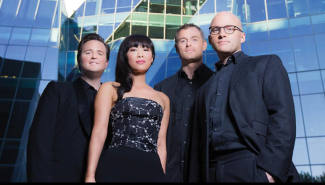
Concert Review: Might And Majesty / The Australian Piano Quartet/ Andrew Goodwin

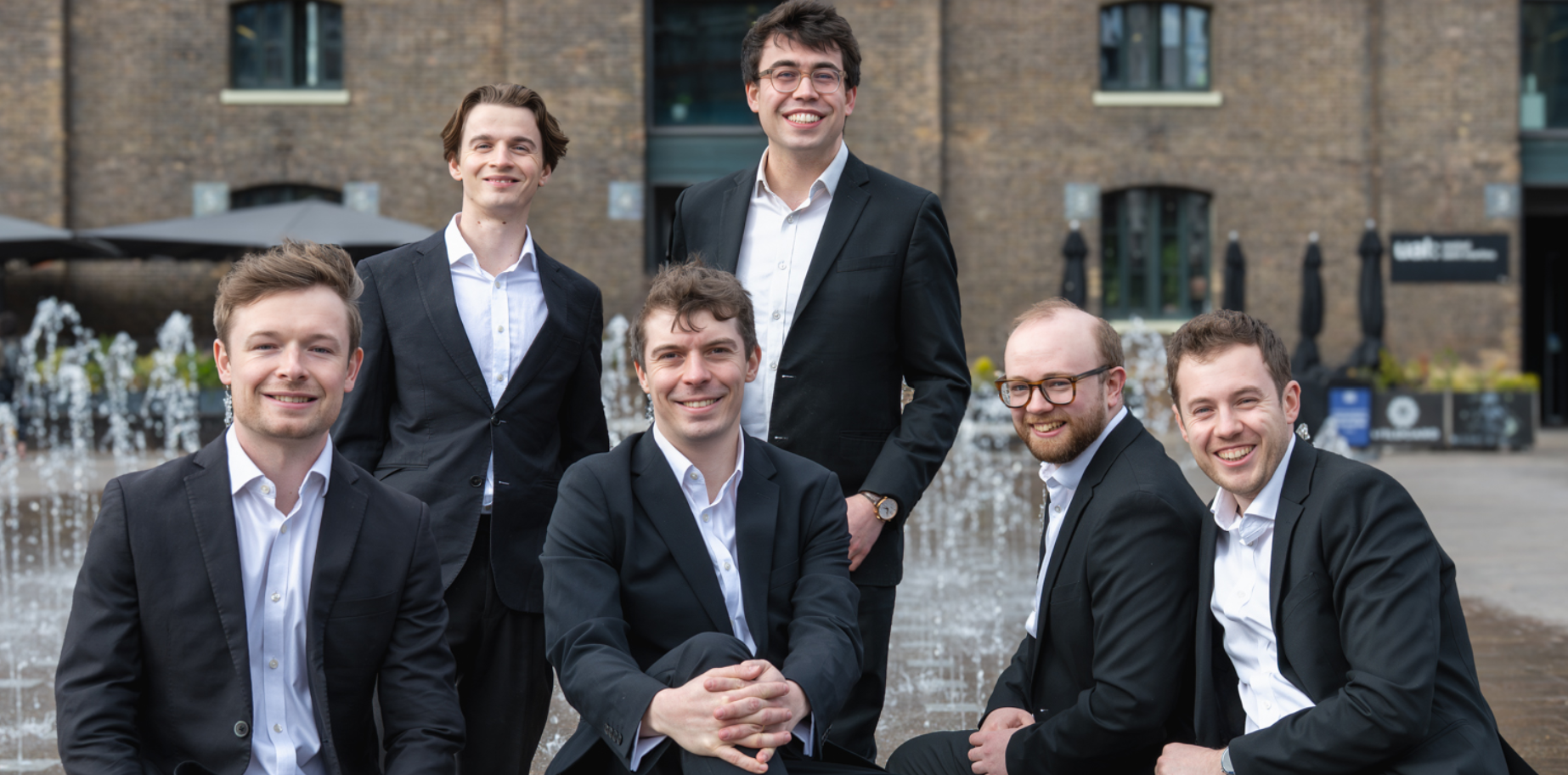
The Australian Piano Quartet – Thomas Rann, Rebecca Chan, James Wannan and Daniel de Borah

Might and Majesty

The Australian Piano Quartet/ Andrew Goodwin, tenor

June 10, 2017

Utzon Room, Sydney Opera House

Written by Ria Andriani

From the first chord to the last bar there was no half measure from the Australia Piano Quartet’s (APQ) performance of Might and Majesty, which included a world premiere of  Your Cruel Melody by Sydney Chamber Opera’s Artistic Director Jack Symonds and Brahms Second Piano Quartet op.26 in A major.

For this concert, the players were joined by Sydney-born tenor Andrew Goodwin in Jack Symonds’ piece which was written for tenor and piano quartet. Commissioned by the APQ, the work reimagined and united the romances of Russian’s five “mighty handful”: Balakirev, Rimsky-Korsakov, Cui, Mussorgsky and Borodin. It was impressive in its wide range of melodic materials as well as use of extended techniques for all instruments and voice. The powerful opening chords from the piano were contrasted with the subtle shifting of harmony by the strings. Your Cruel Melodies made use of Andrew Goodwin’s considerable vocal range: from the chant-like low notes to the delicate high passages. His delivery throughout the performance was no less than outstanding: conveying the emotions of the songs with substance and clear Russian diction – showing just how comfortable Goodwin is with Russian repertoire. There is a personal connection -Goodwin is a graduate of the St Petersburg Conservatoire, which was named after composer Rimsky-Korsakov whose work featured strongly in Symonds’ song cycle.

Goodwin wasn’t the only soloist in Your Cruel Melodies. The work was also complex in other ways: making allusions to the 19th Century works in its instrumental exchanges where ideas appeared and retreated, giving each instrument a moment to stand out. Symonds’ use of extended techniques added to the richness of the texture: featuring frequent glissandi, pizzicato and col legno. Underpinning the whole performance was the piano with its momentum building from sparse to full. The group performed incredibly well in the dry acoustic of the Utzon room despite losing some of the work’s subtler moments.

In contrast to Jack Symonds’ contemporary piece which relied on allusion and texture, Brahms’ Piano Quartet No.2 in A major took the audience back to the heights of 19th Century Romanticism. It gave the group a chance to impress as an ensemble. Having equally challenging individual parts, the group melded into seamless unity from the conversational first movement with coalescing melodic ideas to the rousing ending of the final bars, showing dexterity and gracefulness in between. The key to this piece is the constant symphonic argument which was shared between the piano and stringed instruments. They followed, answered and led, as the music demanded.

There was no doubt that Might and Majesty was a performance worthy of its title, delivered with formidable finesse by this fine chamber music group.

Ria Andriani graduated with Bachelor of Music/ Bachelor of Arts from UNSW in 2015. She now sings as a soprano with various choirs in Sydney, and presents recitals in collaboration with other musicians. Follow Ria on www.facebook.com/RiaAndrianiSoprano

SoundsLikeSydney©

The Australian Piano Quartet returns to the Utzon Room on August 27, 2017 with their next programme, Innocence and Experience. 

Similar Posts

  • Concert Review: Mozart’s Jupiter/ Australian Brandenburg Orchestra

    Mozart’s Jupiter The Australian Brandenburg Orchestra  City Recital Hall, September 3rd, 2014.  The Concerto for Flute and Harp was surely the highlight in this programme of music by Mozart performed by flautist Melissa Farrow and harpist Marshall McGuire with the Australian Brandenburg Orchestra conducted from the fortepiano by Artistic Director Paul Dyer AO. The evening comprised…

  • Concert Review: Midori And Mozart/ Midori Seiler/ Australian Haydn Ensemble

    Midori and Mozart Midori Seiler/Australian Haydn Ensemble Verbrugghen Hall, Sydney COnservatorium of Music, 24 November, 2019. A programme of violin concerti and symphonies by Mozart and Haydn featured in Midori and Mozart, a refined afternoon concert by the Australian Haydn Ensemble, led from the violin by Guest Director and soloist Midori Seiler. The AHE’s Artistic…

  • Concert Review: Music On Music/ Sydney Chamber Choir

    Music on Music Sydney Chamber Choir Great Hall, The University of Sydney  Saturday 30 March 2019 7.30pm Written by Victoria Watson Sydney Chamber Choir was formed in the 1970s by students of Sydney University. In the decades since, it has evolved into a fine, tightly knit ensemble of musicians, dedicated to presenting choral works that…

  • Concert Review: Splendour And Mystery/Sydney Chamber Choir

    Splendour and Mystery/ Sydney Chamber Choir
    Verbrugghen Hall, Sydney Conservatorium of Music
    Australian Digital Concert Hall
    25 March, 2023
    In Splendour and Mystery, Sydney Chamber Choir under the direction of Sam Allchurch joined forces with Camerata Antica led by Matthew Manchester and organist Thomas Wilson in an adventurous anthology of music written for double choir. Specialising in the music of the 16th and 17th centuries, the founder of Camerata Antica, Matthew Manchester playing the fiendishly difficult cornetto, was joined by Michael Wyborn, William Kinmont and Paolo Franks playing the equally challenging alto, tenor and bass sackbutts respectively.
    Bookended with pieces by Giovanni Gabrieli with one of his refreshing Canzonas in the middle, the program also contained music by living Australasian composers Clare Maclean and Brooke Shelley, Gabrieli’s contemporary and student Heinrich Schütz and 20th century composers John Tavener and Frank Martin. Together these composers explore and exploit the potential of the double choir with its opportunities for super-rich harmonies, added melodic lines, imitation, choral interplay and variations in the positioning of the singers.
    The opening motet, Gabrieli’s Jubilate Deo omnis terra, C 65 was quite literally a musical shout for joy. A major part of this journey back in time to Renaissance Venice was the unique sound of Camerata Antica. Heralded by the instruments, the 10 lines of the choir sang an uplifting, lively and tightly dotted chorus, alternating with homophonic passages. Allchurch and his ensemble clearly delineated the rhythms, changing time signatures, hemiolas and other displaced accents which created the buoyancy of this celebratory piece.
    John Tavener’s brilliant A Hymn to the Mother of God transcends the mortal and looks to the cosmic powers of Mother Mary. Writing in the style of canon, with imitative lines that start in quick succession and not necessarily in harmony, Tavener creates a sense of ‘other-worldliness’ in this simple but awe-inducing piece in three-sections. It was a slow burn as the two choirs sang with shimmering lightness and a sense of spinning through space, creating vivid colours and  clusters of clashing chords with impressive control as the voices rose in range and dynamic to its full-bodied climax.
    The program moved imperceptibly to the German Magnificat by Heinrich Schütz, as the choirs were joined by organ and instruments. This was a relevant and important inclusion as Gabrieli himself taught Schütz in this multi-choral technique which Schütz then developed in his own style.
    Clare Maclean’s moving Christ the King was sublimely sung, opening in the manner of a plainchant by the female voices which peeled off into mirroring phrases by the other voices, ending in a reprise of the plainchant. Premiered by this choir in 1984, it is precisely opportunities like these which new composers need for their music to be heard and re-heard until it becomes recognizable to listeners and enters the DNA of the concert repertoire.
    The short and brilliant burst of Gabrieli’s Canzona seconda, C 187  from Camerata Antica showcased these rudimentary instruments in all their imperfect glory as the choir positioned itself for Frank’s only unaccompanied choral work, the demanding  Mass for double choir, considered to be one of the finest and most complex pieces of 20th century choral music. The choir did ample justice to this piece which incorporates the aesthetics of Renaissance music, French Impressionism, Schoenberg’s twelve-note system and J S Bach. The altos began the Kyrie with a freely-flowing, supplicating melody; the Gloria built step-wise to cluster chords; the Credo was a business-like affirmation of faith; the canon-styled Et Resurrexit was levity, hope and word-painting to perfection; the Sanctus introduced softer harmonies from the male voices. The mass, Version 1, ended with a powerful Benedictus. Fast forward to 1926 and Martin added the Agnus Dei, the crowning glory to this choral magnum opus. The mass culminated in a glorious unification of the choirs.
    Brooke Shelley’s Heavenly Father, composed in 2022, performed in the presence of the composer was premiered in November 2022, by the Sydney Chamber Choir. A lyrical and beautifully textured piece, it is very pleasing that it has quickly been programmed again. Like the slightly older piece by Maclean, it is critical that new pieces of merit such as these, are given regular and frequent hearings so that they may be heard widely and face the test of time.
    Finally, Gabrieli’s Magnificat a 14, C 79 brought together the full instrumental and vocal forces of the ensemble. Using the 16th century Venetian technique of cori spezzati (split choirs), the brighter sound of the female voices and cornetto took to the left gallery with the male voices and the thrilling grunt of the bass and other sackbutts in the right gallery with a mixed ensemble placed and organ placed centrally on stage.
    This was an intelligent and audacious program from Allchurch, performed with glorious sound by a choir secure in technique, pitch and musicianship.

  • Review: Songs Of Christmas/The Idea Of North With The Choir Of St James’

    The Idea of North with the Choir of St James’ Saturday, December 6, 2014 The Choir of St James’ concluded their highly successful 2014 season this Saturday gone with Songs of Christmas, a melange of popular tunes and Christmas favourites featuring guest artists and world-renowned a capella superstars  the Idea of North.  I’ve never heard…

  • CD Review: A Celtic Christmas/Australian Brandenburg Orchestra And Choir

    With all the frisson of a live recording, the Australian Brandenburg Orchestra’s newest release A Celtic Christmas, from their 2013 Christmas concerts at Sydney’s City Recital Hall and released on the ABC Classics label (ABC 481 1317), is a refreshing collection of seasonal music that goes beyond traditional fare. Paul Dyer’s indefatiguable capacity to curate…

Leave a Reply