The Marais Project’s Exquisite Harmonies, a new release on the Move Records label is a celebration of music by some of the most famous composers of the French and German Baroque with contributions from contemporary Australians.
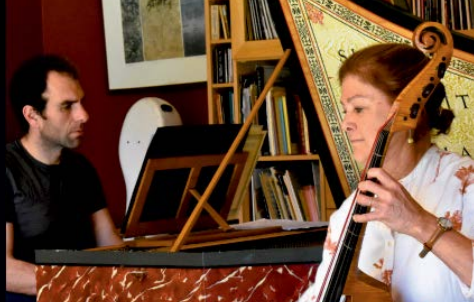
Founder of The Marais Project and viola da gamba player Jenny Eriksson and harpsichordist Anthony Abouhamad play an extensive repertoire of music for viola da gamba and continuo. Violinist and vocalist Susie Bishop and Tommie Anderson playing the gallichon, join for the final track, The Acceptance with words and music by Biripi and Gamillaroi musician and composer, Troy Russell, commissioned by Eriksson and arranged for the ensemble by Anderson.
This is an engaging collection of music from Eriksson and Abouhamad, who bring the past into the present. The ancient, woody, straight-toned sounds of Eriksson’s virtuosic performance on the viola da gamba are well matched with the bright and ephemeral sounds of the harpsichord, which provides the harmonic context to the gamba’s bowed melodies.
The introduction to the album is the short three-movement Sonata in C Major by Carl Friedrich Abel, comprising a lightly ornamented Vivace, a sonorous Adagio with triplet rhythms and graceful, vivacious Minuetto.
Abouhamad has some fun exploring the music of Georg Philip Telemann, with the Fantasia no.5 from ‘Three Dozen Fantasias for Harpsichord’ (Fantaisies pour le clavessin; 3. Douzaines. Hamburg: 1732-33). Composed in three sections (A-B-A1) the first section bubbles along, carefree above a bustling Alberti bass. The middle section contrasts dramatically with minor and diminished chords before returning to the ornamented da capo.
Abouhamad’s articulation and phrasing are pleasing. Careful placement of crucial notes allows a nice build-up of tension. His technique is particularly on show later in the line-up with his solo, Les Silvains by François Couperin, a majestic heavily ornamented, endlessly spinning Rondeau. Often a member of a continuo ensemble it’s a welcome opportunity to hear him as a soloist, as well appreciate his compositional flair in his Fantasia after Telemann (Allegro-Affettuoso-Allegro), which he describes as his “attempt to imitate the compositional model that Telemann presents in his Three Dozen Fantasias.”
Emulating Telemann’s structure, Abouhamad’s Fantasia is also built on the da capo form whose returning third section is perfect for elaborating thematic ideas, using his “knowledge of eighteenth-century counterpoint and harmony to improvise the fantasia at the harpsichord” as he explains in the liner notes adding, “I believe that by practising improvisation and composition we may come closer to experiencing the intimacy and immediacy that eighteenth-century music has to offer.”
Abouhamad’s two Telemann- linked solos are spliced by Telemann’s four-movement Sonata in A Minor for viola da gamba and continuo. The plaintive first movement Largo is followed by an Allegro, a lyrical, trilling Suave which ventures into the extremes of the gamba’s register, and the final motoric second Allegro.
Moving to the French composers, Eriksson has compiled a Grande French Suite, which includes the music of several Baroque masters connected through history. The ‘Overture’ to this Grande Suite is the familiar cameo Les pleurs by Monsieur de Sainte-Colombe and made famous in the movie Tous les matins du monde which narrates the life of that other famous French composer and gambist, Marin Marais.
Louis de Caix d’Hervelois’ Suite in G Minor/Major rightly introduces some dance rhythms in its three movements – the charming L’Agreable, the lively La Fanatique and the stately Allemande.
A collection of French Baroque music for the viola da gamba would be incomplete without the inclusion of music by Marin Marais. For this Eriksson has chosen the three-movement Suite in G Major which has a rustic feel, giving its opening Saillie du Jardin a gently swaying tactus, the following Rondeau le Troilleur, a tribute to the milker, and the light-hearted Le petit badinage.
Closing the bracket of French music with a flourish is the Chaconne La Buisson by Antoine Forqueray.
The final track on Exquisite Harmonies, The Acceptance is a gentle two-verse chant-like song intended to be a musical acknowledgement of country and brings a different kind of ‘ancient’ to the table, uniting old and new.
Exquisite Harmonies is beautifully presented rich with a booklet containing insights, biographies and images. It sits on the cusp of entertainment and historical performance practice. Eriksson and Abouhamad present a lovely partnership, performing eminently listenable music sinking into a time when life seemed simpler and more innocent.
Shamistha de Soysa for SoundsLikeSydney©